

Transporting heavy machinery and industrial goods across borders requires careful planning and robust packaging. Without the right approach, items can sustain damage during handling, shipping, or storage. Understanding best practices for export packing ensures that machinery arrives safely, minimising delays, costs, and operational disruptions.
Choosing the correct packing method involves evaluating the size, weight, fragility, and destination of the goods. While some machinery may require basic protective crates, others need specialised handling and reinforced structures. Proper export packing not only safeguards physical assets but also meets international shipping regulations, customs requirements, and insurance standards.
Understanding the Challenges of Shipping Heavy Machinery
Shipping heavy industrial goods presents unique challenges:
- Weight and Size: Machinery often exceeds standard dimensions, making manual handling impractical and necessitating cranes or forklifts.
- Fragility: Moving parts, sensitive instruments, and electronics can be easily damaged if inadequately protected.
- Environmental Exposure: Moisture, dust, and temperature fluctuations during transit can corrode metal components or impair functionality.
- Regulatory Compliance: Exporting machinery requires adherence to customs regulations, permits, and sometimes hazardous material standards.
Addressing these challenges begins with selecting the correct packing materials and methods tailored to each shipment.
Common Export Packing Methods
Several export packing techniques are widely used for heavy machinery and industrial goods:
1. Crating and Wooden Cases
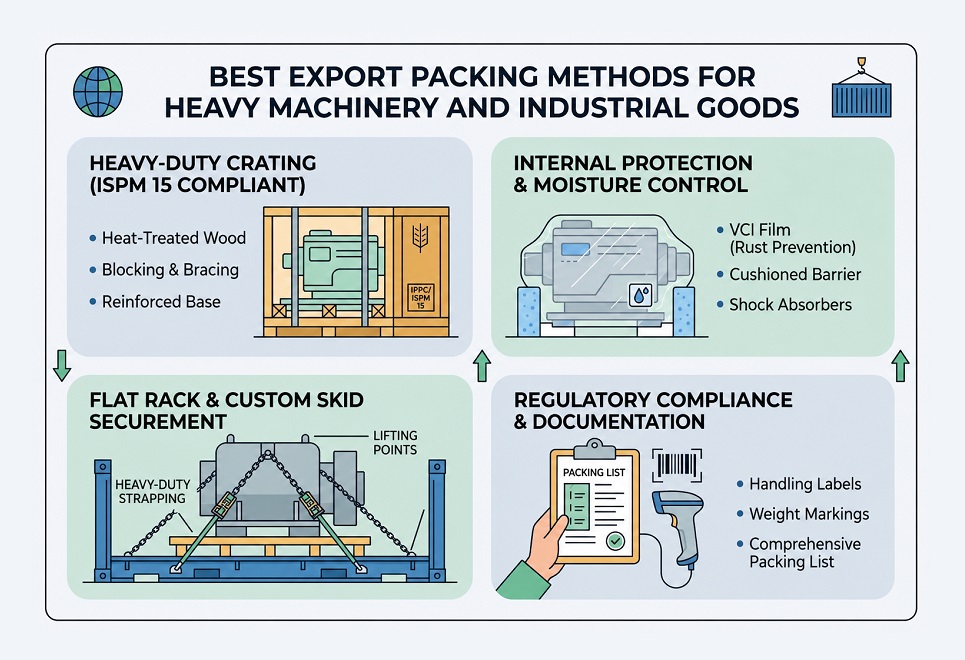
Crates provide rigid support and protection for heavy or irregularly shaped machinery. Wooden cases, often reinforced with steel bands, prevent movement and absorb shocks during transit. They are particularly suitable for long-haul sea or rail shipments.
2. Shrink Wrapping and Protective Covers
For machinery exposed to moisture or dust, shrink wrapping or industrial-grade protective covers provide an additional barrier. This method is cost-effective and works well alongside crates or pallets.
3. Palletisation
Securing machinery on pallets facilitates handling with forklifts and reduces the risk of tilting or toppling. Palletisation is ideal for modular equipment and smaller machinery components.
4. Steel Frames and Skids
For extremely heavy items, steel frames or skids offer structural support while allowing easy loading and unloading. Skids can be customised to fit the base of the equipment precisely, minimising vibration during transport.
5. Custom Shock-Absorbing Packaging
Sensitive machinery often requires packing with foam inserts, vibration dampers, or air-cushion systems. These solutions protect delicate components from impact and ensure equipment functionality on arrival.
Key Considerations for Effective Export Packing
When planning export packing for heavy industrial goods, consider the following:
- Weight Distribution: Ensure the load is evenly balanced to prevent tipping during handling.
- Secure Fastening: Use bolts, straps, or bands to immobilise equipment within crates or frames.
- Corrosion Prevention: Apply anti-rust coatings, desiccants, or moisture-absorbing materials to metal surfaces.
- Labeling and Documentation: Clearly mark handling instructions, weight, and orientation to avoid mishandling.
- Regulatory Requirements: Verify compliance with international shipping standards, including ISPM 15 for wooden packaging.
These considerations help protect machinery, reduce insurance claims, and streamline customs clearance.
Conclusion
Proper export packing is critical when shipping heavy machinery and industrial goods. Using methods such as crating, palletisation, protective covers, and custom shock-absorbing solutions ensures goods arrive in optimal condition. Careful planning, combined with compliance with regulations and attention to environmental factors, protects valuable assets and contributes to smooth international operations. For businesses seeking reliable guidance, partnering with experts in export packing is an essential step towards safe and efficient shipping.